











Two car haulers can sit side by side on the lot at the same length and the same rating and still be the wrong trailer for you. Grandville carries both kinds: Sure-Trac on the open side and Car Mate on the enclosed side. The gap between them is not really open versus enclosed. It is what each one leaves you to load once the trailer itself is on the scale.
Sure-Trac and Car Mate, side by side
Sure-Trac: the open deck
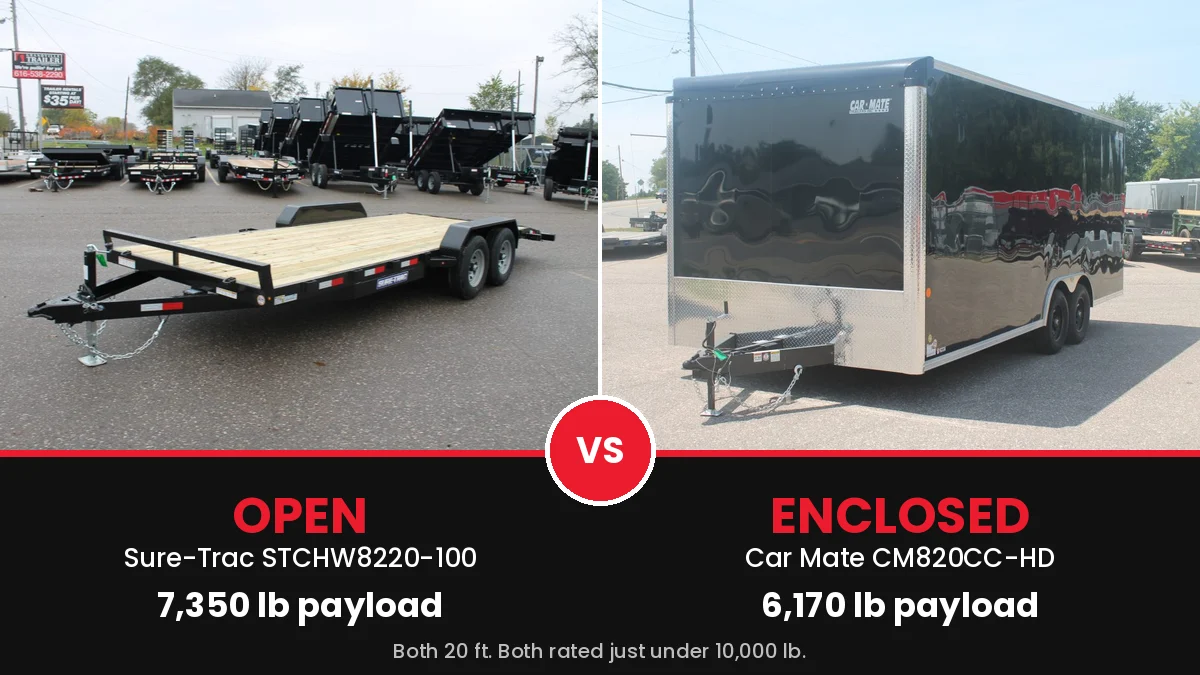
Sure-Trac is built by Novae in Indiana. The car hauler is a steel frame with a wood deck, on leaf-spring suspension. The STCHW8220-100 runs twenty feet with a seven-foot deck and a 9,900 pound rating.
Leaf springs are the older design and they are still the right answer for a lot of buyers. The parts are common and the repair is straightforward, which is worth something on a trailer you intend to keep for years.
Car Mate: the enclosed carrier
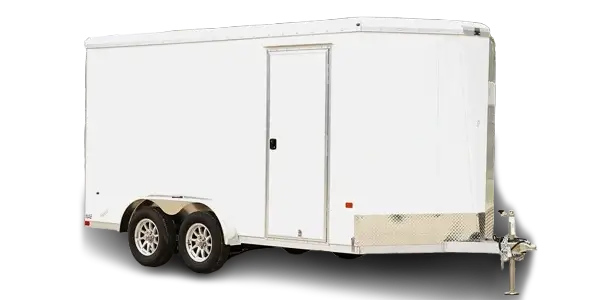
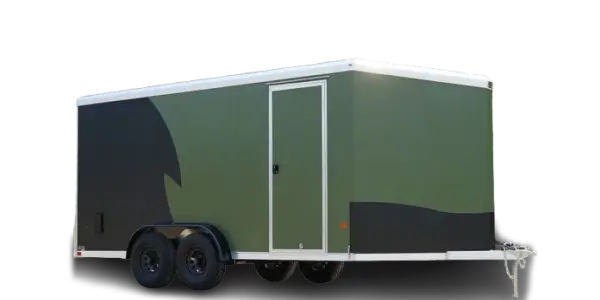
Car Mate has been building trailers for over forty years. The CM820CC-HD is an enclosed trailer built to car hauler size, and Grandville lists it as one: twenty feet again, but a box listed at eight and a half feet wide and seven feet tall, rated at 9,990 pounds, riding on torsion axles.
Torsion suspension rides independently at each wheel, which matters more than it sounds when what you are carrying is a car rather than a pallet of block. Less of the road comes through to the load.
The 1,180 pounds nobody budgets for
Here is the arithmetic that decides this for most people.
| Sure-Trac STCHW8220-100 | Car Mate CM820CC-HD | |
|---|---|---|
| Deck length | 20 ft | 20 ft |
| Width (as listed) | 7 ft deck | 8 ft 6 in box |
| GVWR | 9,900 lbs | 9,990 lbs |
| Empty weight | 2,550 lbs | 3,820 lbs |
| Payload | 7,350 lbs | 6,170 lbs |
Same length. Effectively the same rating. The enclosed trailer weighs 1,270 pounds more empty, and that comes straight off what you can put on it: 1,180 pounds of payload gone before you load anything.
For most cars that is academic. A Miata, a street rod, a side-by-side, a lawn crew’s mowers. None of it is close to six thousand pounds. It stops being academic the moment you are hauling a full-size pickup, a loaded dually, or a car plus a toolbox plus a spare engine, which is exactly the point at which people discover it.
So the question is not which trailer is better. It is whether the weather protection and the lockable box are worth 1,180 pounds to you. If you are hauling a project car four times a year, it almost certainly is. If you are moving heavy vehicles for work, the open deck is doing the job the enclosed one cannot.
Both of these need a title in Michigan
Worth knowing before you are standing at the counter. Michigan requires a title for any trailer with an empty weight of 2,500 pounds or more. Trailers under that weight have to be registered but do not need a title.
Both of these car haulers are over the line. The Sure-Trac only just clears it at 2,550 pounds empty, and the Car Mate clears it comfortably at 3,820. Registration is charged on empty weight too, and at these weights both fall in the 2,500 to 9,999 pound band. Michigan’s permanent trailer plate does not expire, so it is a one-time job rather than an annual one.
Which one fits what you haul
The open deck makes sense when the load is heavy, when you want to see what you are towing in the mirror, and when you would rather spend the money on the vehicle than on the box around it. It also loads faster, and a twenty-foot open deck will take things an enclosed box simply will not: a skid steer attachment hanging over the side, a car with a roof rack, anything taller than seven feet.
Enclosed makes sense when what is on the trailer is worth more than the trailer, when it sits outside between uses, or when the trailer doubles as storage you can lock. The weight penalty is real but so is pulling into a motel parking lot on the way to a show and not thinking about it again until morning.
Both are bumper pull, so neither one needs a gooseneck hitch cut into your truck bed.
The car hauler category page goes further into the mechanics of the choice: deck width, ramp angles for low cars, and where the ten thousand pound line comes from. This post is about which of these two suits the job.
See what is on the lot
Stock turns over, so the live list is the honest answer to what is available today:
If the size you want is not showing, tell us what you are looking for and we will watch for it. That is usually faster than checking back. We also take trade-ins, and our service department works on any make, including trailers bought elsewhere.
Car hauler brand questions
How much payload does an enclosed car hauler give up?
About 1,180 pounds on these two. The enclosed CM820CC-HD gives up that much payload against the open Sure-Trac at the same length and rating. If you are hauling a car well under six thousand pounds, that margin never comes into play and the weather protection is free in practical terms. If you are moving heavy vehicles or a vehicle plus equipment, the open deck is the one that does the job.
What is the difference between leaf spring and torsion suspension on a car trailer?
Leaf springs are simple, cheap to repair and easy to find parts for anywhere. Torsion axles suspend each wheel independently, which gives a smoother ride and is gentler on whatever is strapped down. The Sure-Trac runs leaf springs, the Car Mate runs torsion. Neither is wrong. One is easier to live with over years, the other is easier on the load.
Do I need a title for a car hauler in Michigan?
Yes. Michigan requires a title for trailers with an empty weight of 2,500 pounds or more, and both of these car haulers are above that, at 2,550 pounds for the Sure-Trac and 3,820 for the Car Mate. Lighter trailers under 2,500 pounds have to be registered but do not need a title.
Does Michigan’s permanent trailer plate cover a car hauler?
Yes. Michigan’s permanent trailer plate does not expire, so once a car hauler is plated you are not renewing it every year the way you would a vehicle. Registration itself is charged on the trailer’s empty weight.
What is the difference between a car hauler and an equipment trailer?
Mostly rating and ramps. A car hauler is built around the weight and ground clearance of a vehicle on four tires. An equipment trailer is built for machinery, with heavier ratings, stand-up ramps and often a higher deck. If what you are moving is a skid steer or a tractor rather than a car, start there instead.
Not seeing the size you want? Tell us what you are hauling and we will watch for it.