











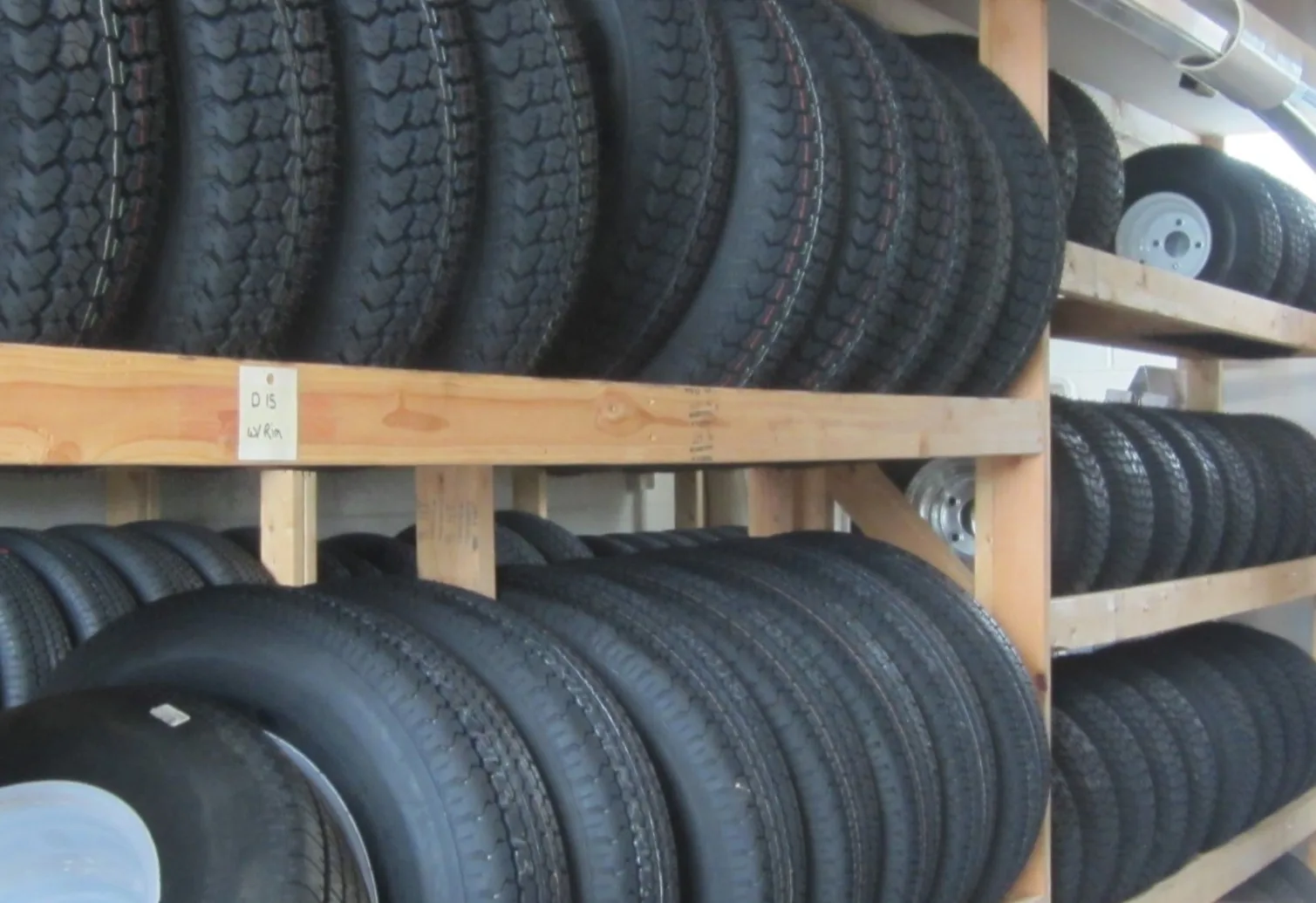
This page is a maintenance guide. For sizes, part numbers and fitment, see trailer tires & wheels for sale: everything we stock, with mounting available while you wait.
Trailer tires do not wear out the way car tires do. They spend most of the year parked, they carry close to their rated load whenever they are actually working, and they give the driver almost no feedback. You cannot feel a soft trailer tire through the steering wheel the way you feel a soft tire on the tow vehicle. The result is that most trailer tires we replace are not worn out. They aged out, ran underinflated, or came apart because a wheel bearing failed first.
This guide covers the maintenance side: how to tell when a tire is finished, what pressure to run, how to repack your own wheel bearings, how to recognize a bearing going bad before it strands you, and what to do if a tire lets go at highway speed. It is written for the trailers we see most in West Michigan: utility, cargo, dump and equipment trailers that work hard in summer and sit through a Grand Rapids winter.
How to tell when a trailer tire is finished
Three separate things retire a trailer tire, and they rarely happen at the same time: tread depth, age, and visible damage. A tire can fail any one of these while passing the other two.
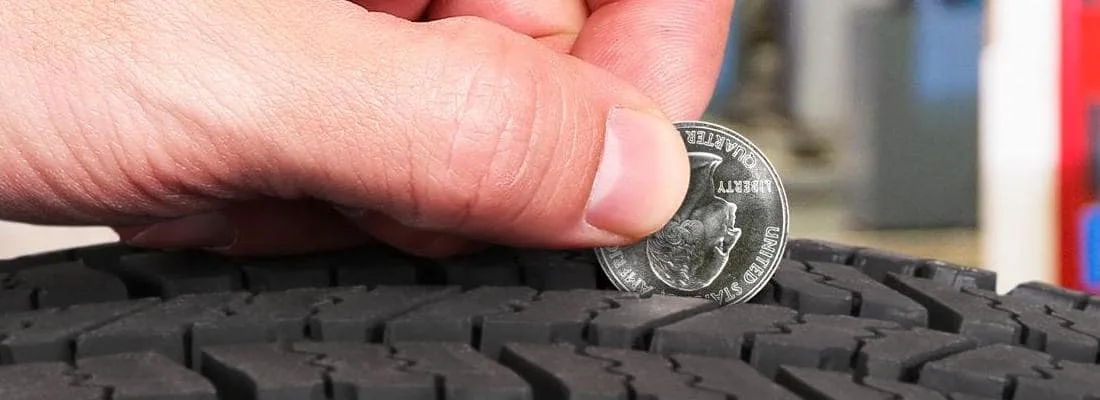
Check the tread with a quarter
You do not need a gauge to get a usable answer. Push a quarter into a tread groove upside down. If the tread reaches the top of George Washington's head, you have at least 4/32" left and the tire has service in it. If the tread does not touch his head, start planning the replacement. Check several grooves across the width of the tire and on both sides of the trailer, because the two rarely wear the same.
How the tire is wearing tells you more than how much is left:
- Worn in the center, shoulders fine: overinflated, or the tire is heavily overrated for the load it actually carries.
- Worn on both shoulders, center fine: chronically underinflated. This is the pattern we see most.
- Worn on one shoulder only: a bent spindle, a sprung axle, or a leaf spring that has settled on one side. Replacing the tire without fixing the axle just buys you another ruined tire.
- Scalloped or cupped: loose or failing wheel bearings, or worn suspension. Fix the cause first.
Read the DOT date code
Every tire carries a DOT code molded into the sidewall, and the last four digits are the build date: two digits for the week, two for the year. A tire stamped 3218 was built in the 32nd week of 2018. If the code has only three digits, the tire is from the 1990s and should have been replaced a long time ago.
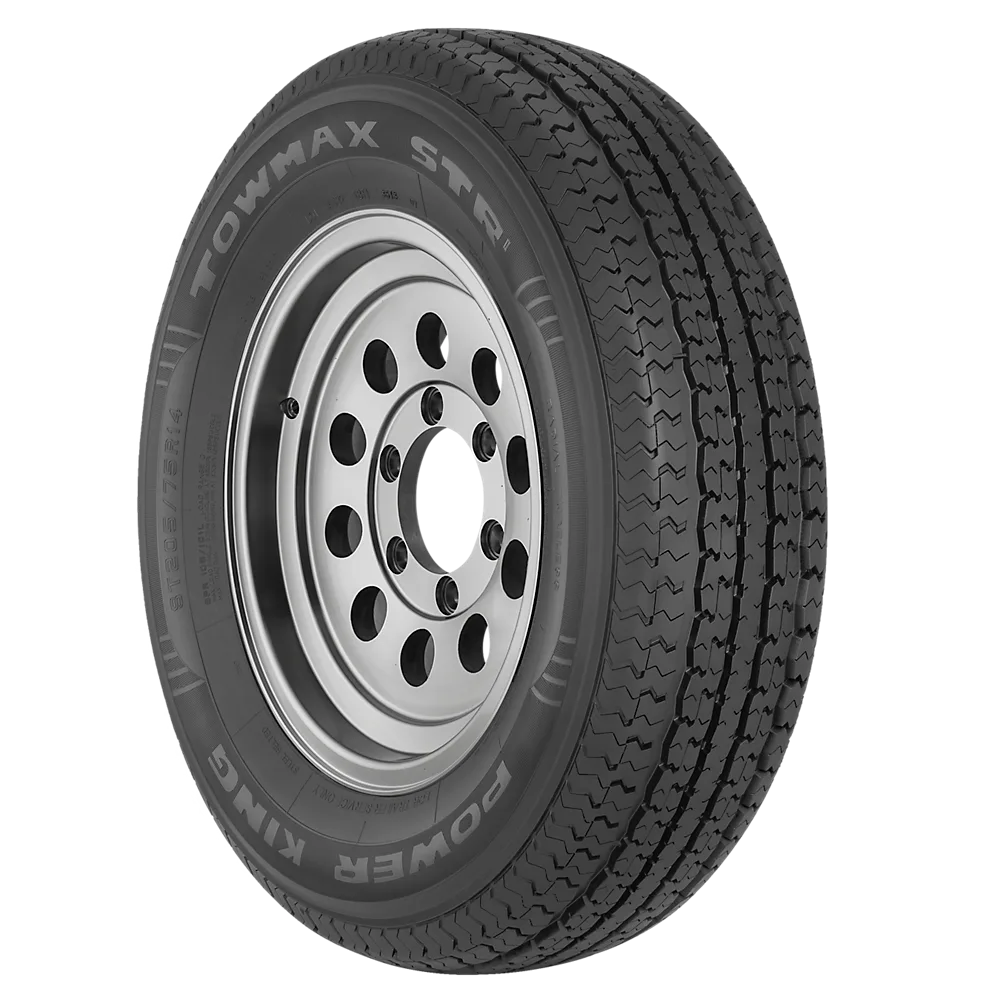
This matters more on a trailer than on anything else you own. A trailer tire that covers 1,500 miles a season will still have most of its tread at eight years old, and it is still unsafe. The rubber oxidizes and the belts separate whether the tire is rolling or not. Plan on replacement every three to five years regardless of how the tread looks. Sunlight, road salt and the freeze-and-thaw cycle we get here all shorten that window.
Damage that means replace now, not later
- Sidewall cracking or weather checking. Fine crazing across the sidewall means the rubber has hardened. There is no repair.
- A bulge or bubble. The internal belt has separated and the sidewall is holding air on its own. This tire will fail, usually under load and usually at speed.
- Exposed cord or steel. Done, immediately.
- Any plug or patch in the sidewall. Sidewall repairs are not legitimate on any tire. Tread punctures can sometimes be repaired properly from the inside; sidewalls cannot.
- Flat spots from long storage. A tire that sat flat on one spot for a season may take a set. If it does not round out within a few miles of warming up, it is finished.
Trailer tire pressure
Improper inflation is the single most common cause of trailer tire failure, and it is the easiest thing on this page to get right.
Unlike a passenger car, where you inflate to the number on the door jamb rather than the number on the tire, ST trailer tires are normally run at the maximum cold pressure molded into the sidewall. That is what the load rating assumes. A tire rated for 2,150 lbs at 65 psi does not carry 2,150 lbs at 45 psi. It carries considerably less, and the difference turns into heat.
Three rules that prevent most failures:
- Check cold. Before you tow, not at the first gas stop. A tire that has been rolling for twenty minutes reads high, and bleeding air out to "correct" it leaves you badly underinflated once it cools.
- Check monthly, and again before any long tow. Tires lose roughly a pound a month on their own, and about 1 psi for every 10°F the temperature drops. A trailer set correctly in July is meaningfully soft by October.
- Include the spare. A spare that has been under the trailer for four years at 20 psi is not a spare.
Also worth knowing: most ST tires are speed rated to 65 mph. Running sustained highway speeds above that generates heat faster than the tire can shed it, even at correct pressure.
DIY: how to repack trailer wheel bearings
Wheel bearings carry the entire weight of your trailer while spinning, and they only survive because they are packed in grease. Over time that grease breaks down, faster if water has worked its way past the seal, which is why boat trailers and anything regularly backed down a wet ramp need this more often than a dry-use utility trailer.
How often: once a year, or every 12,000 miles, whichever comes first. After any submersion, do it regardless of the calendar. And if the trailer has been parked for a season, it still needs the service, because grease breaks down on a stationary trailer too.
What you need: a jack and jack stands, a flat head screwdriver, needle nose pliers, a socket set, wheel bearing grease, new seals, new cotter pins, solvent for cleaning, and rags. Have the new seals and cotter pins in hand before you start; both are single-use.
Step 1: removal
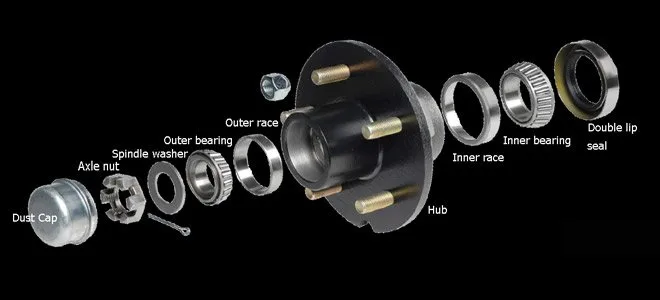
With the axle raised on a jack and supported on stands, remove the wheel and then the dust cap. The flat head screwdriver will pop it off. Straighten the cotter pin, pull it out with the needle nose pliers, then take off the spindle nut and thrust washer and remove the outer bearing.
Step 2: cleaning
Pry the seal out of the back of the hub with the flat head screwdriver. There are neater ways to do this, but the seal is being replaced anyway. With the seal out, the inner bearing comes free. Use solvent to clean every trace of old grease off the bearings, the races, and the hub surfaces. Clean thoroughly: a single piece of grit left in a race will chew up a fresh bearing. While everything is apart, look at the races: pitting, scoring or a blue heat-discolored ring means the bearing set needs replacing rather than repacking.
Step 3: repacking
Put a glob of fresh grease in your palm and work the bearing into it edge-first, pushing grease up through the rollers from the wide side until it comes out the top. Rotate the bearing and repeat all the way around. It is packed when there are no gaps left anywhere in the cage. Add a layer of grease over the outside, and smear grease into the races in the hub before the bearing goes back.
Step 4: replacing the seal
Set the inner bearing in place and tap a new seal in squarely, so it sits even and snug with the hub face. Driving a seal in crooked is the most common way a fresh repack ends up leaking within a season.
Step 5: assembly
Put the drum back on the axle. A little more grease on the spindle face does no harm. Fit the thrust washer and spindle nut, and check that the drum spins freely. Insert a new cotter pin, cover it with the dust cap, and put the wheel back on. Then do the other side.
A few things that make the difference between a repack that lasts and one that does not:
- Do not torque the spindle nut. Snug it while spinning the hub, then back it off to the nearest cotter pin hole. Torquing it crushes the bearings and they will fail quickly.
- Always fit a new cotter pin. Reusing a bent one is how a spindle nut walks off.
- Never mix grease types. Lithium and polyurea greases are not compatible and the mixture can liquefy and run out.
- Do both sides. They have the same age and the same miles.
- Bearing buddies help, but they are not a substitute. They keep positive pressure against water intrusion; they do not clean out broken-down grease.
Signs a wheel bearing is going bad
A failing bearing gives warning if you know what to look for. Ignore it and the spindle overheats, the bearing seizes or disintegrates, and in the worst case the wheel leaves the trailer. Spindle damage turns a routine repack into a new axle.
- A hot hub. After twenty minutes of towing, put the back of your hand near each hub. Warm is normal. Too hot to touch, or noticeably hotter than the other three, is a problem. Do this at every fuel stop on a long trip. It is the single most useful trailer habit there is.
- A growl or rumble that changes with speed. Not with braking, and not with steering. If it rises and falls with road speed, suspect a bearing.
- Play in the wheel. Jack the wheel off the ground, grip it at twelve and six o'clock and rock it. Any noticeable movement means the bearing is loose or worn.
- Grease slung on the inside of the wheel or the back of the brake drum. The inner seal has failed and the grease is on its way out.
- A wheel that will not spin freely once the drum is off, or that spins with a gritty feel.
Tire blowouts: how they happen and how to react
What causes a blowout
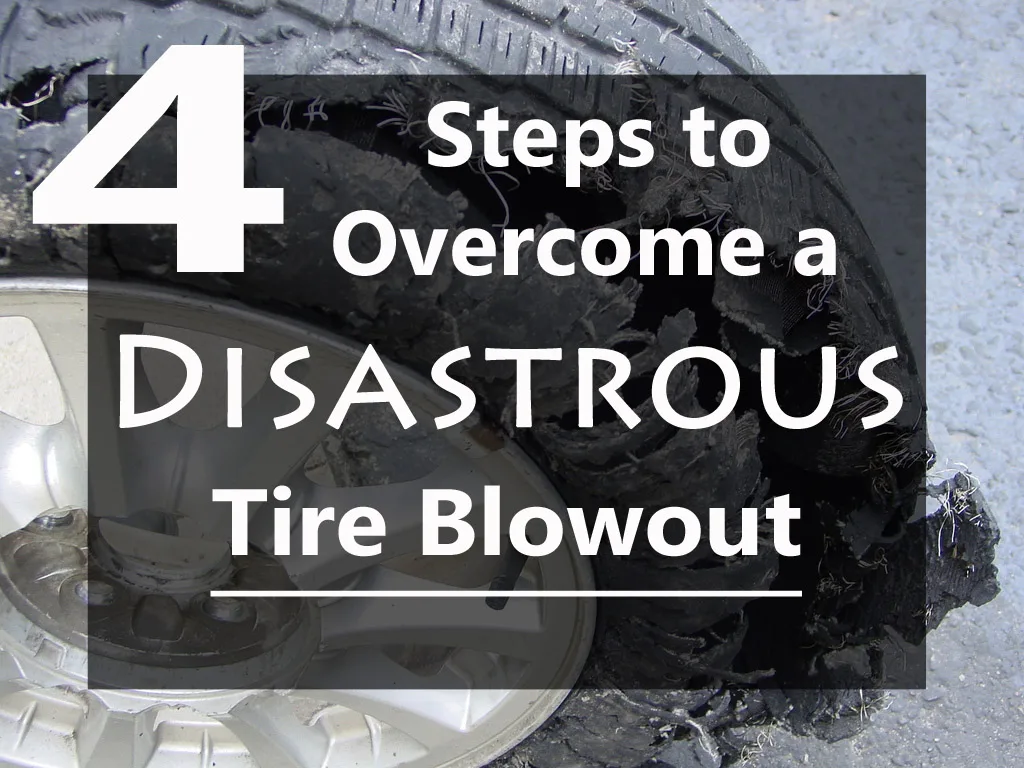
- Improper inflation. Far and away the most common cause. An underinflated tire flexes, heats, and separates.
- Potholes. Hear, hear, o people of Michigan. Beyond avoiding them, you can report them: in the Grand Rapids area, call 311.
- Worn tread. Less rubber over the belts means less protection from road debris and less heat capacity.
- Age. An eight-year-old tire with full tread is a blowout waiting for a warm afternoon.
- Overloading. Add up the load rating of every tire on the trailer. That total should exceed the weight of the loaded trailer by about 20 percent. If it does not, every tire is running at its limit and one of them will find its limit first.
What to do when one lets go
The instinct is to brake and steer for the shoulder. On a trailer, that is exactly the wrong sequence, because braking shifts weight forward and lets the trailer start swinging. Do this instead:
- Accelerate. Briefly and firmly. It feels wrong, but a short burst of throttle pulls the rig straight and stops the trailer from overtaking you.
- Counter steer gently. Small corrections. A sharp input at this point starts a sway you will not recover.
- Slow down gradually. Come off the throttle and let the rig lose speed on its own rather than braking hard.
- Pull over. Once you are down to a walking pace and stable, get as far off the road as you can. Chock a good wheel before you jack anything.
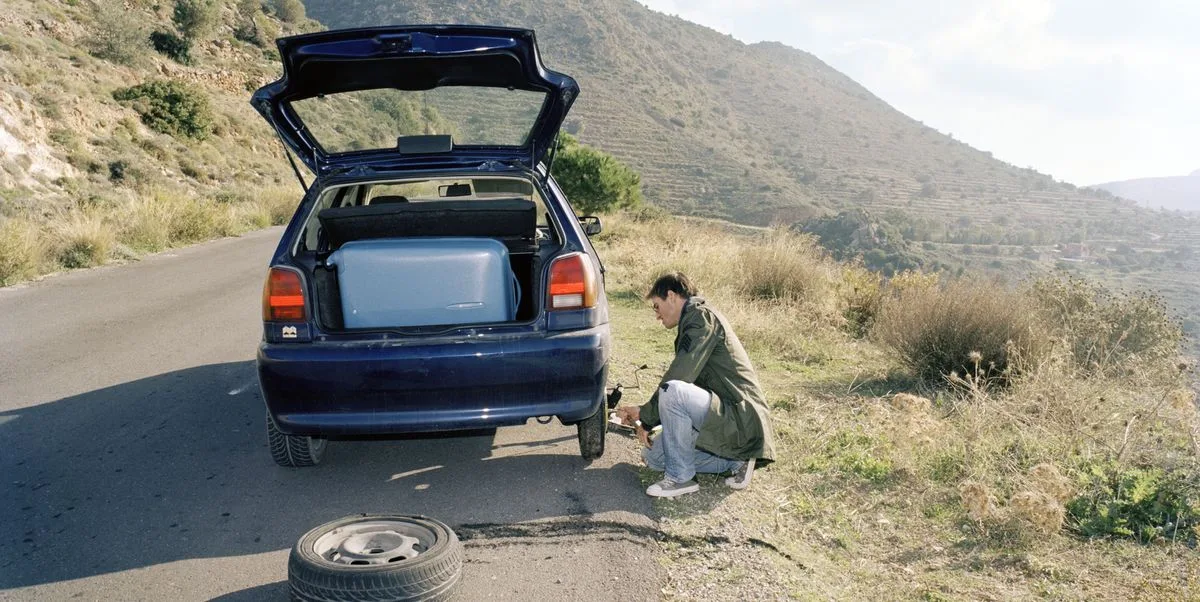
Carry what you need to actually use a spare: a spare that fits and holds pressure, a lug wrench that fits the trailer lugs rather than the truck's, a jack rated for the loaded axle, wheel chocks, and a pressure gauge.
Lug torque and re-torque
Trailer wheels loosen after service far more often than car wheels do, because trailer lugs seat into the wheel over the first few miles. Tighten in a star pattern, never in a circle, and then re-torque after the first 10, 25 and 50 miles of towing. Do it again after the first 100 miles for good measure.
Torque depends on stud size (roughly 90 to 120 ft-lbs for 1/2" studs and 120 to 140 for 9/16"), but check the figure for your specific axle, or ask us and we will look it up. Overtightening stretches studs and warps drums; undertightening loses the wheel.
Storing a trailer through a Michigan winter
- Inflate to the maximum cold pressure before it sits. A tire stored soft develops a flat spot and a stressed sidewall.
- Get the weight off the tires if you can: blocks or stands under the frame. If you cannot, move the trailer a few feet every month or two so it is not resting on the same patch of rubber all winter.
- Keep them out of the sun. UV is what causes sidewall cracking. Covers help; so does parking on the north side of a building.
- Park on gravel or concrete, not grass or bare dirt. Ground moisture works into the rubber from below.
- Skip the tire shine. Petroleum-based dressings pull the protective oils out of the sidewall.
- Repack the bearings going into storage, not coming out. Fresh grease displaces the moisture that would otherwise sit against the races all winter.
A five-minute check before every tow
- Pressure on all tires, cold, including the spare.
- A quick look at tread and sidewalls on both sides.
- Lug nuts tight, especially if the wheels have been off recently.
- Hub temperature by hand after the first twenty minutes on the road.
- Lights, coupler, safety chains and breakaway cable.
Trailer tire and bearing FAQs
How often should trailer wheel bearings be repacked?
Once a year or every 12,000 miles, whichever comes first. Sooner for any trailer that gets backed into water, and before a trailer goes into long-term storage.
What grease should I use?
A grease specifically rated for wheel bearings, with a high dropping point, marine grade if the trailer sees water. The important part is not mixing types. If you do not know what is in there, clean it all out and start fresh.
Can I repack bearings myself, or does it need a shop?
It is a genuinely doable job with basic tools and an afternoon, which is why the walkthrough above exists. Bring it to us if you find pitted races, a scored spindle, or a hub that has been running hot. Those need parts and a press rather than grease.
What pressure should my trailer tires be?
The maximum cold pressure molded into the sidewall, unless your trailer's manufacturer specifies otherwise. Set it cold, before towing.
Do bearings need replacing, or just repacking?
Repacking is the routine service. Replace the bearing and race as a set if you see pitting, scoring, blue heat discoloration, or any roughness when you spin the bearing by hand. Races and bearings are matched, so never put a new bearing in an old race.
My trailer sat all winter. What should I check first?
Pressure and sidewalls before you move it, then hub temperature after the first twenty minutes. If it has been more than a year since the last bearing service, do that before the first real trip rather than after.
Can I use car tires on a trailer?
No. Passenger tires are built to steer, accelerate and grip; ST trailer tires have stiffer sidewalls built to resist sway and carry load while being pulled. Neither works properly in the other's job.
Trailer service at Grandville Trailer
Our full service garage handles all of this: bearing repacks, seal and race replacement, brake service, tire mounting and balancing, and axle work when a tire has been telling you something the tire itself could not fix. If you would rather not spend the afternoon in grease, schedule trailer service or call the shop.
Need parts or tires instead? Our parts department stocks bearings, seals, hubs, lights and the rest, and every size and price we carry is listed on the trailer tires and wheels page, with mounting available while you wait. Questions can also go to Sales@GrandvilleTrailer.net.