











Trailer Tires For Sale
Wait... Grandville Trailer has trailer tires for sale too? Yes! For some reason, people are commonly surprised to hear that we carry wheels and tires at our store. I'm here to tell you, we absolutely do!
We have a store on our lot that is well stocked with all the best parts and accessories needed for your setup: Lights/wiring, brakes, hitches/ball mounts, tool boxes, ladder racks, e-tracks, floor mats, bearings and tons more. And of course, wheels and tires! You won't see them immediately when you walk into our store. Our trailer tires for sale are in a separate room next to the parts counter.
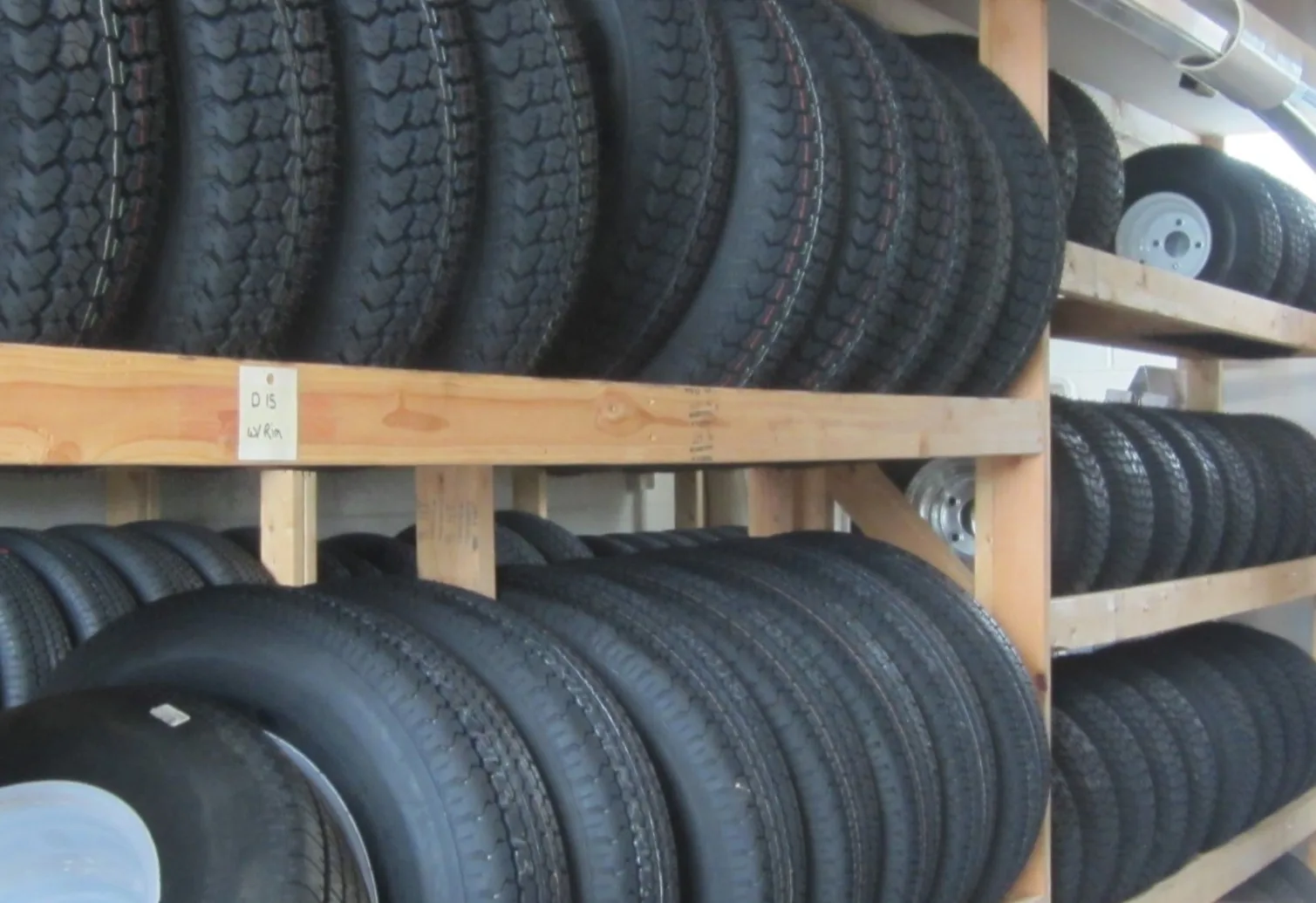
A great time to buy your second set of tires is when you buy your trailer. With every new trailer purchase, you get 10% off parts and that includes trailer tires.
I hope you find this complete trailer tire guide helpful. If you know what you need, you can skip the article and head straight to our service and parts departments by tapping the buttons below. On those pages you can request parts or start scheduling your trailer service. Otherwise stick around to learn more about our trailer tires for sale and how to care for them!
| Parts Department |
| Service Garage |
About our Trailer Tires
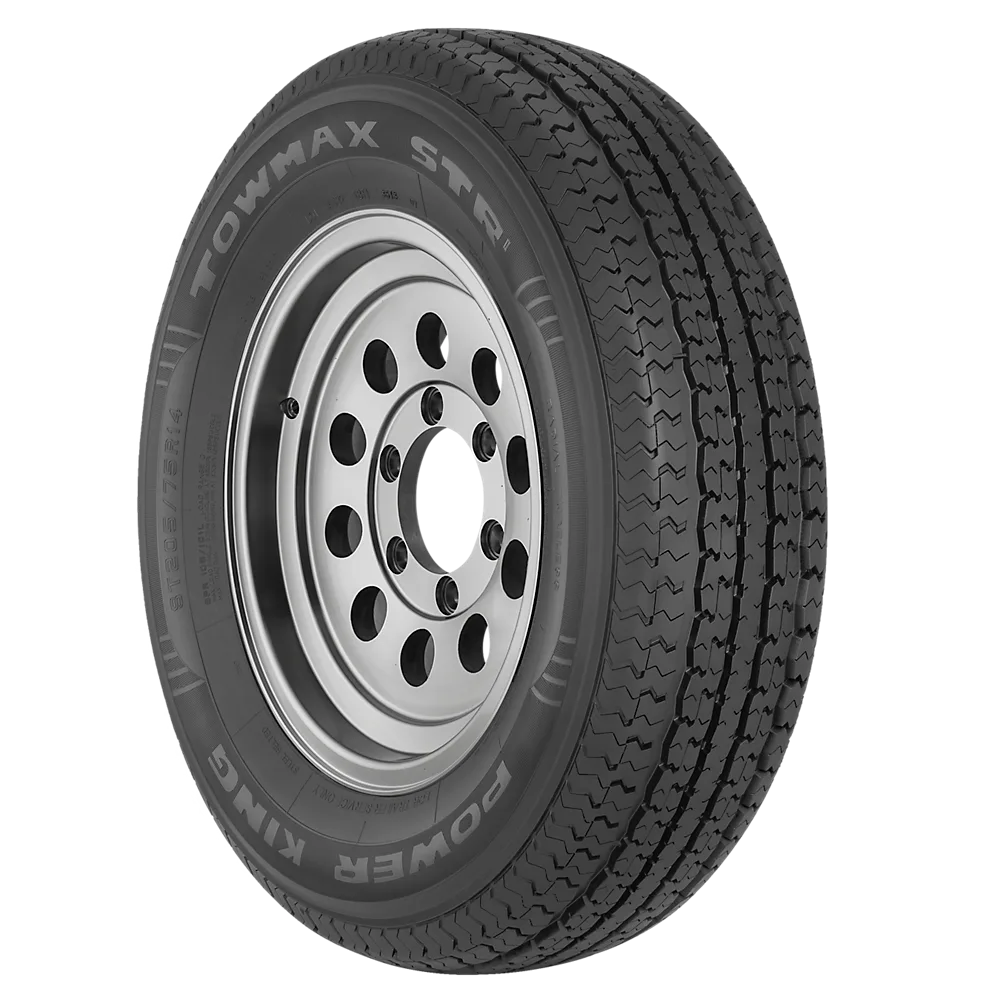
We carry the Power King Towmax tires and here's a few things that make them a good choice:
- Optimized tread compound for improved rolling resistance
- Computer-designed tire profile to improve resistance to heat build-up
- Nylon overlays on 15'' and 16'' sizes for superior strength and durability
- Nationwide limited warranty
- 2-year nationwide roadside assistance program
Trailer Tire FAQs
1. How often do you need to replace trailer tires?
Answer: Depending on the usage, Trailer Tires need to be replaced every 3-5 years or between 5,000 and 12,000 miles.
2. How much weight can trailer tires carry?
Answer: Add together the weight capacity of all your trailer's tires. The combined total should exceed the weight of your loaded trailer by 20 percent.
3. Can you put vehicle tires on a trailer?
Answer: No! Vehicle tires and trailer tires are made for different purposes. The tires on your truck are designed to accelerate, steer, and have traction on the road. Trailer tires are designed to be pulled and just go along for the ride. You should never use a trailer tire on a car or vice versa.
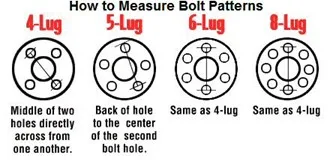
4. How do you measure a bolt pattern?
Answer: On a wheel with an even number of bolts, simply measure from the middle of one bolt to the middle of the bolt on the other side. On a wheel with 5 bolts, measure from the back of one bolt to the middle of the second bolt. Here's a picture to help clear it up:
5. Do you offer service for trailer tires?
Answer: We do just about everything in our full service garage! We can absolutely replace your tires and repack your wheel bearings. If you'd like to repack your wheel bearings yourself, keep scrolling for a full tutorial!
DIY: How to Repack Wheel Bearings
Why do you need to repack wheel bearings?
The wheel bearings need to stay well lubricated to work properly while bearing the weight of your trailer. Unfortunately, over time the grease breaks down, especially if water works its way inside the bearings. Therefore, it's important to repack wheel bearings with grease on a regular basis. It is required to do so every year or 10,000 miles.
It's one of those "adulting is hard" chores that just has to get done whether or not you feel like it. And hey, if you don't want to do it, bring it in! Our guys can repack wheel bearings like it's their job. We are more than happy to do this for you at our shop; we take pride in providing the best trailer service in west Michigan.
If you're here, then you'd probably rather DIY and save some money. That's great! We put together this quick step by step tutorial to help you along the way.
Before you begin, you will want to have all your materials out and ready to go. Here is a complete list of everything you might want to use.
Materials Needed
Hammer
Needle-nose pliers
2 Jack stands
Large flat head screwdriver
Large adjustable wrench
Wrench for lug nuts
Solvent
New cotter pin
Bearing grease
Gloves
Clean rags
Small pan
Some of these things can be substituted with a different tool, however having all these things on hand will help you do get the job done in a quick and *somewhat* clean manner. Once you have these things it's time to get in and get your hands dirty!
STEP 1: REMOVAL
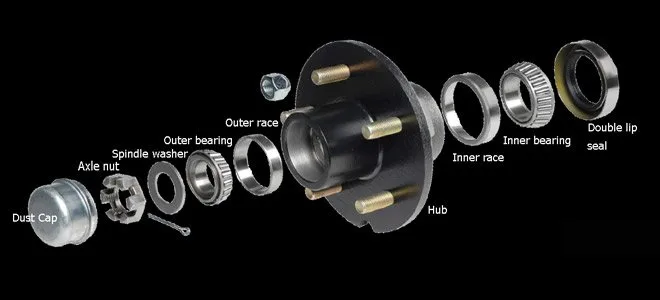
With the axle raised on a jack, remove the wheel and then the dust cap. The flat head screwdriver will work to take off the dust cap. Next, remove the cotter pin by unbending it and pulling it out with your needle nose pliers. And finally remove the rear bearing.
STEP 2: CLEANING
Now it is time to take the seal out of the bearing. There are several ways to do this but we recommend simply prying it out with your flat head screwdriver. Once that is out, you can remove the inner bearing as well. Use solvent to clean all the old grease off of the bearings, races, seal and hub surfaces. It's important that you clean all parts thoroughly!
STEP 3: REPACKING
Once everything is out and clean, you can do the actual repacking. Do this by putting a glob of fresh grease on your palm and begin working it into the bearing. Make sure that it is fully packed and no gaps remain. It's also ideal to add another layer of grease around the rollers, on the bearing race surfaces on the hub and the bearing's faces. Basically, anywhere you can put new grease; do it. Grease= good.
STEP 4: REPLACING
Once you're done playing in the grease, tap in a new seal, ensuring that it is even and snug.
STEP 5: ASSEMBLY
Really, the only thing left is to just put it all back together. Place the drum back on the axle (maybe add yet another glob of grease to its face). After the careful placement of the thrust washer and spindle nut, the drum should easily spin on the axle. Insert the new cotter pin and cover with the dust cap. After putting the wheel back in place, you're done! Well... with that one wheel, anyways.
Here is an additional list of tips to help you get the job done perfectly:
- If your trailer has been in storage for some time, it still needs this service done. Grease will break down on a parked trailer, too.
- Don't torque the spindle nut when you are re-assembling. It will crush the bearings. Just make sure it is snug.
- Always replace the cotter pin.
- And just in case you happen to be "that guy" stranded on the highway, we think it's a good idea to carry an extra set of seals and bearings, all which you can find in our parts department.
TRAILER SERVICE AT GRANDVILLE TRAILER
This simple task should take you about an hour to complete and is something that most people can do on their own at home. However, if you can't find the time or space to do it yourself, need to bring your trailer in for another reason anyways, or are just having a bad Tuesday, we are more than happy to do this for you! That's what we're here for. Do you have an extra set of seals and bearings stored in your truck or trailer? If you don't, you might consider swinging by and grabbing some. If you want to tackle this project at home, we are more than happy to answer any questions you have while you are here!
| Service Department |
Tire Blowouts: How They Happen and How to React
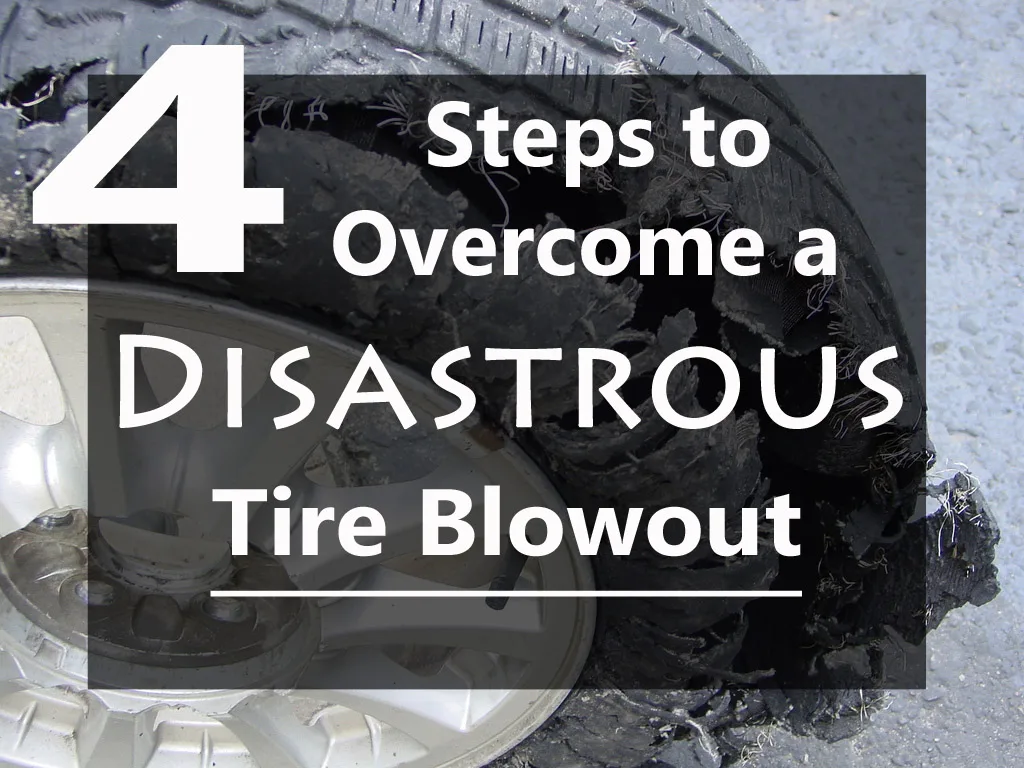
Did you know that colder temperatures will lower the air pressure in your tires? Low pressure results in more friction between your tires and the road. More friction leads to a greater chance of a tire blowout. This is what was on my mind this chilly October morning as I was bringing my kids to school. Looking at both the first frost of the year and the tire pressure signal on my dashboard.
Unlike a flat tire, a tire blowout is when your tire explodes, leaving behind dangerous debris and causing a sudden pull to one side. Each year, blown tires cause more that 78,000 accidents with over 400 of them being fatal. It is imperative that you know how to react in this situation. The proper response to a tire blowout might not be what you expect.
Before we go on, take a look at the video of a driver who did not know what to do when their tire blew.
I've gotta say, his reaction is pretty awesome! I can't imagine being so calm after rolling a car. There are dozens of other videos that result in spinning, rolling and hitting other cars. Some people aren't as fortunate as the guys in this video.
These videos made me realize how common this is, and even worse, I didn't know exactly what I should do if this happened to me. Think about it, we see shredded tires all over the highway; it happens all the time. So let's take a look at some of the common causes of tire blowouts and then the four steps to surviving one.
What causes a blown tire?
- Improper Inflation- This is, without a doubt, the most common cause of tire failure. An under inflated tire creates friction between the rubber and pavement. In this case, it's only a matter of time until you're on the shoulder of the highway.
- Potholes- Hear, hear, o people of Michigan! This is bad news for us. Other than doing your best to avoid them, there is one thing you can do. If you're in the Grand Rapids area, you can report them by calling 311!
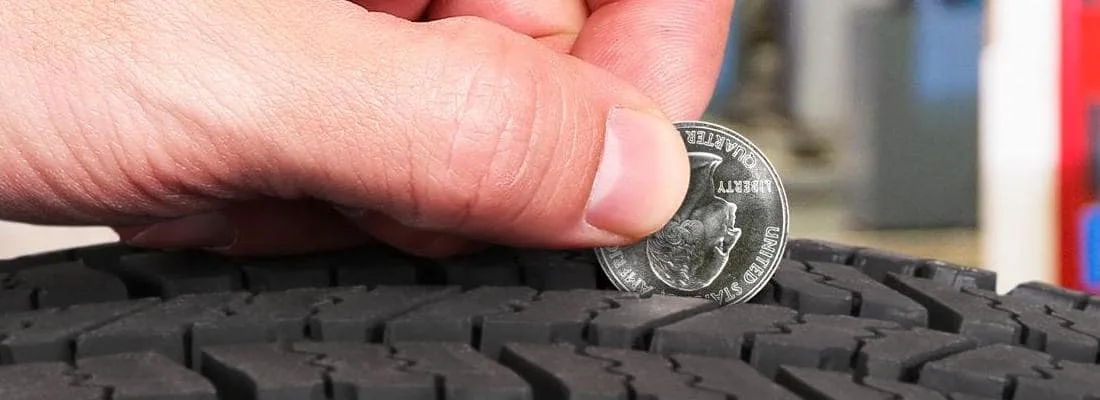
- Worn Tread- Along with checking your tire pressure every month (when the tires are cold) be sure to check the actual treads. If they are 4/32" or deeper, you are good to go.
TIP: A quick quarter test can tell you if your tires are still good. As pictured below, stick the quarter upside down into one of the grooves. If the tire comes up to the top of George Washington's head, you still have at least 4/32" tread. If it doesn't touch his head, it's time for new tires. Be sure to check a few different spots on your tires.
Grandville Trailer sells trailer tires!
Even if you remember to take perfect care of your tires, the truth is, they can still have a blowout. Especially in Michigan, the weather can change quickly and potholes can be big enough to home a family of raccoons. Some risk factors are out of our control, which is why it is necessary to be prepared for tire failure.
What to do if You Have a Tire Blowout
You'll know instantly if you have a blown tire. There will be a loud popping sound and then a strong pull on the vehicle to one side. Here's what your immediate next few steps should be:
1. ACCELERATE
This counterintuitive first step might have been a surprise to you. After all, it goes against the natural urge to hit the brakes and get to the shoulder as soon as possible. When you have a blown tire creating drag, stepping on the accelerator a little harder will not actually speed up your vehicle. But it will stabilize your vehicle in your lane and help you to regain control.
Do not: Step on the brake.
2. GENTLY COUNTER STEER
The goal here is to keep your car perfectly straight here, so don't over react. When you try turning a vehicle with a failed tire at high speeds, you'll end up like the guys in the video above. What I mean by counter steering is to gently guide the vehicle straight down your lane. If your vehicle is pulling to the left, carefully push towards the right just enough to keep it from veering.
Do not: Jerk the steering wheel.
3. SLOW DOWN
At this point you should have decent control of your vehicle. Without stepping on the brake, slowly pull your foot off the gas to let your vehicle slow down on its own. With the dragging tire, slowing down won't take long at all. By now, you or a passenger should be able to switch on the hazard lights as well.
Do not: Abruptly take your foot off the gas.
4. PULL OVER
When your vehicle has slowed to around 30 MPH, and you feel that it is safe, very slowly guide your vehicle to the shoulder of the highway. There you can bring your car or truck to a complete stop and let out a sigh of relief.
Do not: Pull over too quickly.
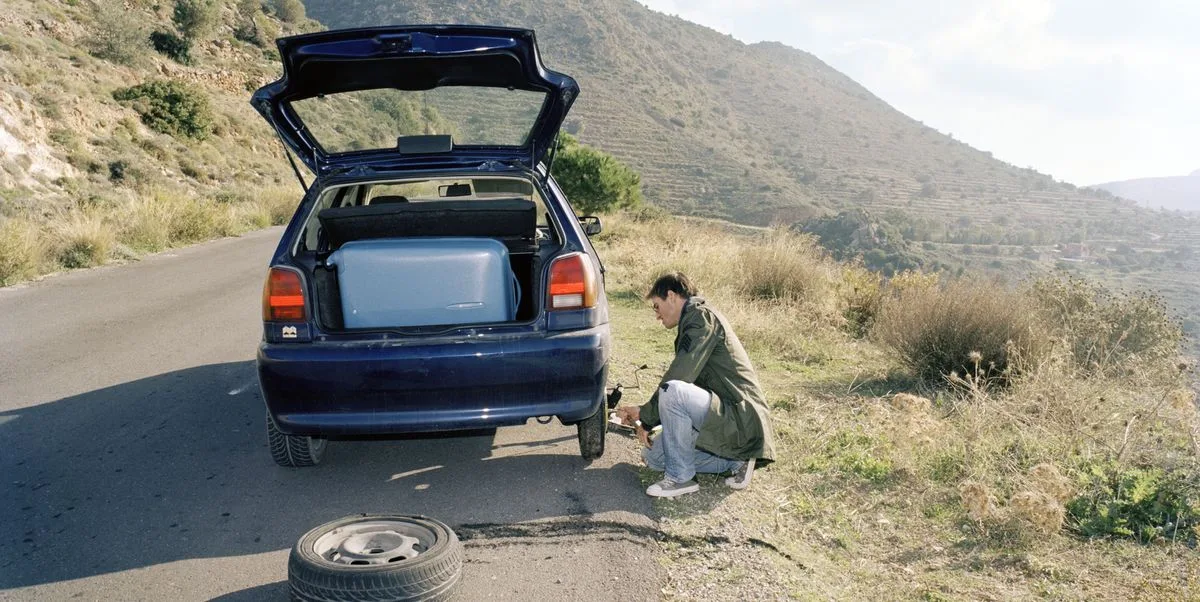
We teach our kids to stop, drop and roll if they find their clothes are on fire. We know not to swerve when there's a deer in the road. It's better to brake and maybe hit the deer than a tree or another car. Smothering a fire on yourself, hitting the deer, and driving through a tire blowout are all counterintuitive, but they're all effective. Keep these 4 steps in mind and run through them in your head when you're driving.
Just like CPR and first aid skills, I hope you never have to use this information, but knowing it could be life saving someday.
If you need new trailer tires, trailer service or anything trailer related let us know!
We're pullin' for ya!
Sales@GrandvilleTrailer.net
Call or text: (616) 538-2290